LRD Watch DR1 · catalog object
LRDW J100031.96+022243.3
Images
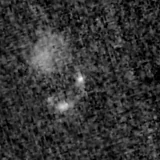
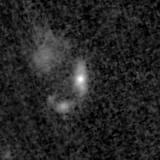
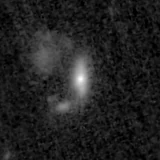
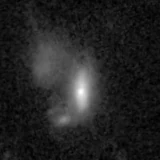
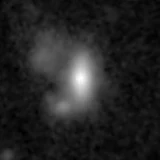
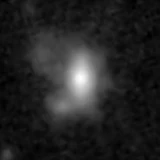
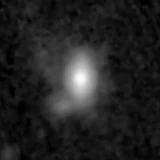
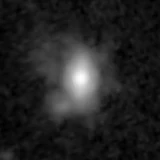
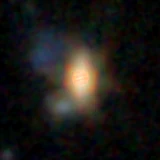
3.2″ across, north up, east left, resampled from the deepest mosaic covering the object in each band; ticks mark the catalogue position. Each band is stretched on its own noise; the composite shares one flux scale, so its colour is real.
Spectral energy distribution
- NIRCam wide
- NIRCam medium
- 2σ upper limit (S/N < 2)
At a glance
- Tier
- TENTATIVE
- Found by
- BH* channel
- Redshift
- 1.868 DJA grade 3, grating
- Spectral shape
- no PRISM spectrum de Graaff+25 criteria
- F444W
- 21.91 AB S/N 629, 0.16″ aperture
- F277W − F444W
- not in the colour lane
- BH* share
- 0.69 cliff_degraaff25; Δχ² galaxy 14.1, dwarf 165.5
- Compactness
- growth ratio 2.502 stars 2.250
- Balmer break
- 18.74 ± 2.06 F150W/F090W, red:Hb+OIII
- Image vetting
- half-stack pass; no flags raised
- Literature
- 0 catalogue(s), 1 AGN paper(s) within 0.026″
Vetting
- Image vettingnot applicable
- Half-stack testpass
- Artifact risknone
- Neighbournone
- Extendedno
- BH* channelBH* share 0.69 below 0.8 (composite)
Redshifts
Each redshift keeps its own column. Photometric redshifts of little red dots are unreliable: against spectra, about a third of AGN-template redshifts (z_agn; 31 of 95 in the last purity run) and about half of galaxy-template redshifts at z > 3 were catastrophic outliers (methods Section 8).
| Column | What it is | z | Source |
|---|---|---|---|
z_spec | Spectroscopic, DJA grade 3 | 1.8677 | bluejay-north-v4_g395m-f290lp_1810_19572.spec.fits |
z_vet | Adopted by vetting | 1.8677 | zspec:dja_specz_grade3.csv:19572 |
z_phot | Photometric (P(z) peak) | — | not fitted |
z_bhs | BH* channel fit | 1.634 | cliff_degraaff25 |
z_agn | Colour-lane fit | — | — |
Spectral checks
- V-shape (spectrum)
- no PRISM spectrum
- Star (spectrum)
- no
- V-shape (photometry)
- not measurable βUV not measured, βopt not measured at z_agn
- Line in F410M
- none 0 line-free optical band(s)
- Line-ambiguous
- no
- Settling verdict
- not evaluated
Literature
Published objects within 1″ of this position. A match is a positional recovery, not an adopted classification.
- Baccus+2026 (z<=3) broad-line AGN
Photometry
Circular aperture of radius 0.16″ at each band's native resolution, background from a 0.40–0.65″ annulus, programmes combined by inverse variance. For a point source multiply by the field's aperture correction (r = 0.16″ → 0.70″). Grey rows are below S/N 2.
| Band | Instrument | Pivot (µm) | f (nJy) | σ (nJy) | AB mag | S/N | Ap. corr. |
|---|---|---|---|---|---|---|---|
| F090W | NIRCam wide | 0.902 | 74.53 | 8.17 | 26.72 | 9.1 | 1.15 |
| F115W | NIRCam wide | 1.154 | 532.04 | 8.86 | 24.59 | 60.0 | 1.12 |
| F150W | NIRCam wide | 1.501 | 1396.58 | 9.14 | 23.54 | 152.8 | 1.11 |
| F200W | NIRCam wide | 1.989 | 2525.74 | 10.36 | 22.89 | 243.7 | 1.09–1.11 |
| F277W | NIRCam wide | 2.762 | 3933.06 | 9.38 | 22.41 | 419.2 | 1.20 |
| F300M | NIRCam medium | 2.990 | 4482.61 | 18.40 | 22.27 | 243.6 | 1.22 |
| F356W | NIRCam wide | 3.568 | 5083.03 | 9.80 | 22.14 | 518.7 | 1.24 |
| F360M | NIRCam medium | 3.624 | 5306.18 | 18.12 | 22.09 | 292.8 | 1.24 |
| F410M | NIRCam medium | 4.082 | 5661.34 | 15.76 | 22.02 | 359.3 | 1.26 |
| F444W | NIRCam wide | 4.404 | 6233.71 | 9.91 | 21.91 | 628.8 | 1.27 |
Provenance
- Field
- COSMOS (PRIMER) (
cosmos) - Programmes
01837, 02321, 07814behind every mosaic the field measured- Pipeline rows merged
- 1 all at one position
- Detection pass
- original
- Release build
33af9933d1cc2026-10-17T14:29:44Z
Image sources
| Band | Mosaic | Native pixel | Coverage |
|---|---|---|---|
| F090W | jw01837-o003_t003_nircam_clear-f090w_i2d.fits | 0.031″ | 1.00 |
| F115W | jw01837-o003_t003_nircam_clear-f115w_i2d.fits | 0.031″ | 1.00 |
| F150W | jw01837-o003_t003_nircam_clear-f150w_i2d.fits | 0.031″ | 1.00 |
| F200W | jw02321-o002_t001_nircam_clear-f200w_i2d.fits | 0.031″ | 1.00 |
| F277W | jw01837-o003_t003_nircam_clear-f277w_i2d.fits | 0.063″ | 1.00 |
| F356W | jw01837-o003_t003_nircam_clear-f356w_i2d.fits | 0.063″ | 1.00 |
| F410M | jw01837-o003_t003_nircam_clear-f410m_i2d.fits | 0.063″ | 1.00 |
| F444W | jw01837-o003_t003_nircam_clear-f444w_i2d.fits | 0.063″ | 1.00 |
Cite
Anderson, Jordan (2026). LRD Watch DR1: little red dot candidates from an independent search of public JWST imaging (Version DR1) [Data set]. Cerin Amroth Research. Zenodo. https://doi.org/10.5281/zenodo.23062632 Object LRDW J100031.96+022243.3.
CC BY 4.0. Please also acknowledge the JWST programmes that took the data. LRD Watch DR1 is a vetted candidate catalogue, not a complete census: it has no selection function and cannot on its own give number densities. About the release.